01
The core specification
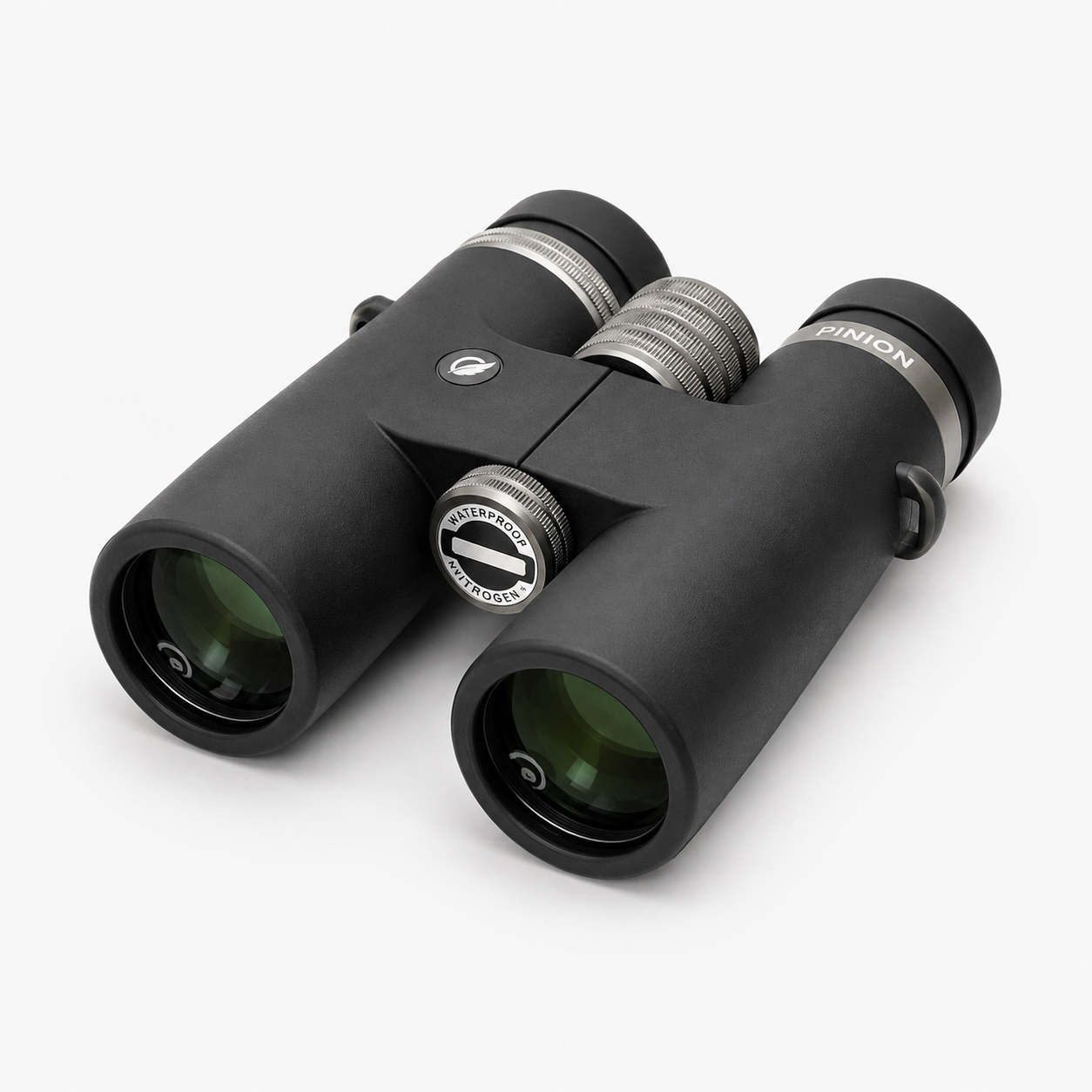
The first number is magnification. The second is the objective lens diameter in millimetres. 8×42 means the image is magnified 8 times through a 42mm front lens. Try any combination below.
Magnification
8×
Objects appear this many times closer
Objective lens
42mm
Full size, around 650 to 750g
Exit pupil
5.3mm
42 ÷ 8. Bigger is brighter
Twilight factor
18
Higher resolves more detail in dim light
02
Exit pupil and low light
Divide objective by magnification to get the exit pupil, the width of the beam of light leaving the eyepiece. Your own pupil opens to around 2 to 3mm in daylight and 5 to 7mm at dusk. If the exit pupil is smaller than your pupil the view looks dim. A 5mm exit pupil is excellent for dawn and dusk observation.
Your pupil
about 6mm at dusk
Exit pupil
42 ÷ 8 = 5.3mm
The beam is narrower than your pupil, so the view will look dimmer than the naked eye scene.
Magnification
Objective lens
Light
8×42 gives a 5.3mm exit pupil
Available as Pinion 8×42 HD and ED.
03
Field of view and eye relief
Field of view is how wide a scene you can see at 1000m. Eye relief matters for spectacle wearers. Look for 15mm or more and twist the eyecups down so your glasses sit at the right distance.

Pinion 8×25
91m at 1000m
Pinion 8×42 HD
123m at 1000m
Pinion 10×42 HD
105m at 1000m
Illustrative crops of the same scene. Field of view figures are the published specifications for each model.
Frequently asked questions
What is eye relief?+
The distance from the eyepiece at which you see the full field of view. Spectacle wearers should look for 15mm or more and twist the eyecups down.